Commercial Roof Repair: Signs, Costs, and How to Choose the Right Contractor
Commercial roof problems rarely start with a dramatic waterfall in the lobby. More often, they begin as a small seam opening, a cracked flashing at a pipe penetration, or a drain that clogs and lets water sit longer than it should. The challenge is that small defects can spread moisture through insulation and across the deck—quietly increasing repair scope and disrupting tenants later.
This guide breaks down what to look for, why leaks happen, what repair options actually fit each roof type, what drives cost, and how to choose a contractor who can fix the root cause (not just patch the symptom). If you need a pro to evaluate your roof, you can Call 469-340-0990 or Schedule a Roof Inspection.

Timely inspections help locate entry points early—before moisture spreads through insulation and into occupied spaces.
Top CTA: Get Your Commercial Roof Evaluated Fast
Active leak? Ceiling stains? Ponding water? A same-week inspection can help prevent rapid damage to insulation, decking, and interiors—and give you a documented plan you can act on.
Tip: When you call, share the roof type (if known), building height, and where you’re seeing symptoms so the team arrives with the right materials and safety plan.
Commercial Roof Repair: Protect Your Building, Tenants, and Budget
Commercial roof repair is less about “patching a hole” and more about protecting a system: membrane (or panels), insulation, cover board, deck, flashing details, and drainage. When any layer stops performing, you can see interior damage, safety risks, and unplanned downtime.
Key takeaway
If you can see water inside, the roof system may have been wet for longer than it looks. Water can travel laterally through insulation and along decking before it finds a path down—so the visible leak is often not directly under the entry point.
If you’re new to commercial roofing diagnostics, it helps to know what a real inspection should include. For a deeper walkthrough, see Commercial Roof Inspection: What to Expect, Why It Matters, and When to Schedule One.
Top CTA: Get Your Commercial Roof Evaluated Fast
When you’re searching for commercial roof leak repair near me, speed matters—but so does method. A strong evaluation balances urgency with the discipline to find the real entry point(s), confirm moisture conditions, and recommend a repair that won’t fail in the next storm.
What a fast, professional assessment should accomplish
- Document current conditions with photos and notes you can share with ownership, property management, or insurance.
- Identify likely entry points (penetrations, drains, edges, transitions) and map the roof’s high-risk zones.
- Check moisture so repairs address hidden wet insulation rather than trapping water inside the system.
- Provide options that fit your roof’s age and type—repair, restoration, or replacement—with a practical timeline.
Operations reality: Many commercial repairs fail because the plan ignores rooftop traffic patterns. Service paths to HVAC units and frequent access points need reinforced details, walkway pads (where appropriate), and a drainage plan that stays functional during heavy storms.
Common Signs Your Commercial Roof Needs Repair
Commercial roofs can leak for weeks before you get a clear interior drip. That’s why the best “early warning system” is a consistent mix of interior checks, exterior observations, and performance clues (like HVAC run time).
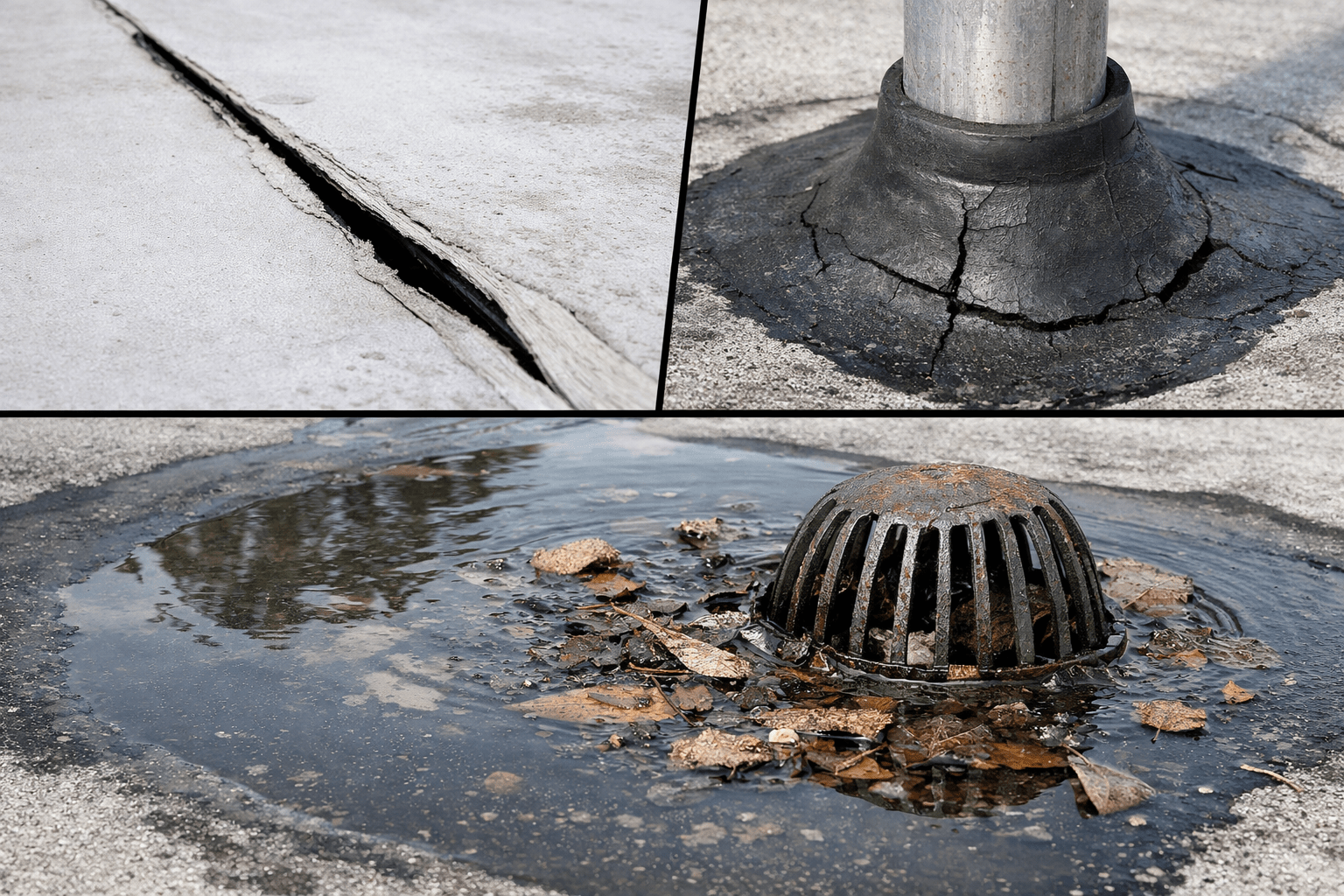
Many leaks start at details: seams, penetrations, and drainage points.
Interior warning signs (what tenants and staff notice first)
- Water stains on ceiling tiles, gypsum board, or walls—especially after wind-driven rain.
- Musty odors in upper floors or near perimeter walls, which can indicate long-term moisture in insulation.
- Bubbling paint or peeling finishes, often a sign moisture has been present long enough to affect substrate.
- Drips that move from one storm to another—water can shift based on wind direction and ponding location.
Exterior indicators (what a roof walk often reveals)
- Membrane blisters or ridges that can signal trapped moisture or adhesive issues.
- Open seams in single-ply systems or failing lap joints on modified bitumen.
- Cracked flashing around pipes, skylights, curbs, and HVAC penetrations—common leak sources.
- Deteriorated sealant at terminations and transitions (parapets, edge metal, wall ties).
- Loose fasteners, rusted metal edges, or displaced coping that can point to wind uplift problems.
Performance clues that often get missed
- Ponding water that remains 48 hours after rainfall—a major risk factor for seam failure and accelerated aging.
- Higher energy bills or new hot/cold spots that can indicate wet insulation (reduced R-value) forcing HVAC to work harder.
- Recurring small leaks after “simple patches,” suggesting the original entry point wasn’t addressed or materials were incompatible.
Fast triage checklist (before the roofer arrives)
- Note when the leak happens: only during heavy rain, only with wind, or even days after a storm.
- Mark interior locations (grid lines, suite numbers, distance from exterior walls).
- Photograph stains and ceiling conditions for documentation.
- If safe, confirm whether rooftop drains are clogged (do not access the roof without proper safety measures).
What Causes Commercial Roof Leaks and Failures?
Most commercial roof leaks don’t start in the middle of a field membrane. They start at details—places where materials meet, movement happens, and weather loads concentrate.
1) Details and transitions (the most common origin of leaks)
Penetrations, curbs, parapet walls, edge metal, and transitions are where the roof system has to flex with thermal cycling. When the building expands and contracts, sealants and flashing assemblies take the stress first. Over time, small gaps open and water follows.
2) Drainage problems that amplify tiny defects
Clogged drains, poor slope, or undersized scuppers increase ponding. Ponding doesn’t always cause a leak by itself, but it magnifies every small vulnerability. A seam that might hold under normal runoff can fail when submerged repeatedly.
3) Wind uplift and rooftop traffic
Wind events can loosen fasteners and stress edge conditions. Meanwhile, foot traffic—especially to service HVAC and other equipment—creates punctures, scuffs coatings, and damages seams in predictable lanes. A contractor who understands your service patterns will recommend reinforcement where it matters most.
4) UV and temperature extremes
UV exposure and temperature swings age membranes and coatings. Over time you may see shrinkage, brittleness, and seam separation. This is one reason “the roof was fine for years” can suddenly become “we can’t keep up with leaks” in a single season.
5) Poor prior repairs or incompatible materials
Patchwork repairs without diagnosing the root cause often lead to repeats. Incompatibility matters too: certain sealants, mastics, and tapes don’t bond long-term to specific membranes (or they fail under ponding). A good scope explains the system-compatible repair method—not just a generic patch.
Repeat-leak pattern: If you’ve repaired the same general area multiple times, the issue may be wet insulation, a hidden split at a termination, or drainage that keeps stressing the same seam. A moisture scan and a review of water flow paths can save months of recurring calls.
Commercial Roof Repair Options (By Roof Type)
Commercial roof repair services should be matched to the roofing system—not forced into a one-size-fits-all patch. Below are common options by roof type and what they’re best for.
Single-ply (TPO, PVC, EPDM)
Single-ply systems usually fail at seams, flashings, penetrations, and terminations. Typical repairs include:
- Seam re-welding (TPO/PVC) or re-adhering/lap repairs (EPDM), especially where heat-welds have aged or pulled.
- Targeted patches to address punctures, cuts, or localized membrane damage.
- Flashing repairs at pipes, curbs, and edges using compatible materials and manufacturer-approved methods where applicable.
If you’re researching flat roof repair for commercial buildings, single-ply repairs are often highly effective when moisture is limited and details are rebuilt correctly.
Modified bitumen
Modified bitumen roofs can be durable, but they’re detail-sensitive. Common repairs include:
- Localized patches (torch-applied or adhesive methods depending on system and site constraints).
- Cap sheet repairs and reinforcement in high-stress zones like corners, drains, and transitions.
- Flashing and drain work where splits or bridging occur.
Metal roofing systems
Metal roof leaks frequently originate at fasteners, panel laps, penetrations, and aged sealant lines. Repair may include:
- Replacing failed fasteners and washers and correcting back-out issues.
- Resealing laps and upgrading detail execution where movement is causing separation.
- Rust remediation and panel replacement if corrosion has compromised watertightness.
- Flashing upgrades at pipes, curbs, and transitions.
Spray foam and coating systems
Foam and coatings can be strong candidates for restoration when the base system is viable. Typical work includes:
- Re-coating to renew waterproofing and reflectivity.
- Foam touch-ups and surface prep to eliminate weak spots and improve adhesion.
- Crack and penetration sealing to maintain continuity.
When repairs need to include tear-off (in controlled zones)
If moisture scanning or core cuts confirm saturated insulation or deteriorated decking, the best “repair” isn’t a surface patch. It’s a controlled tear-off in affected areas to remove wet materials and rebuild properly. This is often the difference between a repair that lasts and one that becomes an ongoing maintenance headache.
Repair vs. Restore vs. Replace: How to Decide
The most cost-effective choice depends on system age, moisture conditions, and how widespread the defects are. Your decision should also account for code requirements, disruption tolerance, and long-term ownership plans.

A documented inspection (photos, moisture findings) helps stakeholders choose the right path—and justify it.
Choose Repair when…
Damage is localized, the roof is relatively young, and moisture readings show insulation is mostly dry. The goal is to correct specific defects (seams, flashings, punctures) and restore watertight performance quickly.
Choose Restoration when…
The roof is aging but generally sound, and details can be reinforced. Restoration (often coatings/overlay approaches) can extend service life and improve performance without full replacement.
Choose Replacement when…
Leaks are widespread, insulation is saturated in multiple areas, or the system is at end-of-life. Replacement may be the best long-term value when you’re spending too much on recurring calls.
Make the decision with…
Photos, moisture/infrared findings, and a clear scope. This documentation is especially helpful for owners, property managers, and insurance conversations.
A practical decision framework
- Confirm roof type and age (and any existing warranties or manufacturer requirements).
- Map defects by category: seams, penetrations, edges, drainage, mechanical damage.
- Verify moisture (non-destructive scanning plus selective verification where needed).
- Compare life-cycle value: repair now vs. restore vs. replace—based on realistic service-life extension and risk.
- Plan for operations: after-hours work, tenant communication, safety, staging, and access to rooftop equipment.
If your facility includes manufacturing or high-traffic industrial operations, you may also benefit from reviewing service considerations in Industrial Roofing Services.
What Impacts Commercial Roof Repair Cost?
There isn’t a single “commercial roof repair cost guide” number that fits every building—because the cost is driven by access, complexity, moisture scope, and the repair method required to fix the cause (not just the symptom).
Key cost drivers (what actually changes the scope)
- Roof size, height, and access: loading, staging, lift requirements, and safety planning scale with building complexity.
- Detail density: more penetrations, parapets, and curbs typically mean more labor-intensive flashing and termination work.
- Roofing system type: single-ply seam work vs. mod-bit reinforcement vs. metal fastener replacement have different labor/material profiles.
- Moisture conditions: removing wet insulation and replacing compromised decking increases cost—but often reduces long-term spend by preventing repeat leaks.
- Scheduling constraints: after-hours work, tenant coordination, and restricted access can add planning time while minimizing disruption.
- Documentation and warranty goals: some restoration systems require strict prep and application standards to qualify for warranty options.
Budget truth: The most expensive repair is the one that has to be done twice. Paying for proper diagnostics and compatible materials is often cheaper than repeating “quick fixes” that don’t address moisture and movement at details.
How to compare estimates (so you’re not comparing apples to oranges)
When you receive proposals, look for clarity in three areas:
- Scope detail: exact areas addressed, method (weld/patch/replace), and how penetrations/edges/drains are handled.
- Moisture plan: what happens if wet insulation or damaged decking is found—allowances, unit pricing, or a defined contingency approach.
- Closeout and verification: final photos, manufacturer documentation where applicable, and the communication plan for your team/tenants.
If you manage multiple properties in North Texas and want broader context on regional service considerations, see Roofing Solutions for Homes & Businesses in Denton, TX: Repair, Replacement & Maintenance.
Middle CTA: Stop Small Issues From Becoming Major Damage
Even minor seam openings or flashing cracks can let water travel and saturate insulation far from the visible leak point. A proactive repair plan prioritizes drains, penetrations, edges, and rooftop equipment zones to reduce repeat calls.
Ask for a written scope with photos so you can compare options and confidently brief ownership or property management.
How to Choose a Commercial Roofing Contractor
Choosing the right contractor is less about the lowest number and more about proof: diagnostics, system knowledge, safety planning, and a scope that clearly ties each repair to a cause. Here’s how to vet a contractor for commercial roof repair services without wasting time.
Look for commercial specialization (not just “we do roofs”)
Commercial systems are detail-heavy and performance expectations are different from residential. Ask what systems they repair most often (TPO/PVC/EPDM, modified bitumen, metal, coatings) and how they handle recurring leak scenarios.
Ask what diagnostics are included
A reliable contractor can explain their process clearly. At minimum, you want:
- Roof walk-through with photo documentation
- Review of drainage and rooftop penetrations
- Moisture scanning (when symptoms suggest it) and a plan to verify findings
- A written scope that lists what is repaired, how it’s repaired, and what materials are used
Evaluate their safety plan and communication plan
Commercial roofs involve fall protection, access control, and jobsite coordination—especially on occupied buildings. A professional contractor will outline:
- Access points and rooftop safety measures
- Work hours and tenant/employee communication steps
- Protection of equipment, walk paths, and sensitive operations
- Daily progress updates and closeout documentation
Verify licensing, insurance, and relevant experience
Request proof of insurance and examples of similar commercial projects—ideally those involving complex details (multiple penetrations, parapets, rooftop units). Ask how they handled “mystery leaks” and what changed after diagnosing the root cause.
Prioritize contractors who recommend maintenance after repairs
A strong contractor doesn’t disappear after the patch. They’ll recommend a realistic maintenance plan (semi-annual or annual, depending on building type and environment) focused on drains, penetrations, and traffic zones.
If you want a broader contractor selection framework (documentation, scope clarity, and how to compare bids), this resource can help: How to Choose the Right General Contractor in Denton, TX. While it isn’t roofing-specific, the due-diligence principles apply directly to commercial repair decisions.
Questions to ask before hiring
- What do you believe is the root cause of the leak, and what evidence supports that?
- Will you perform moisture scanning or other diagnostics if needed?
- How will you address drainage (clogs, slope issues, debris, scuppers) to prevent repeat problems?
- What materials will you use, and are they compatible with my roof system?
- What’s the safety and communication plan for an occupied building?
- What does closeout include (photos, documentation, warranty info if applicable)?
Conclusion: A Practical Path to Fewer Leaks and Lower Long-Term Spend
Commercial roof repair works best when it’s systematic: identify the entry point, verify moisture conditions, fix the details that actually fail (seams, penetrations, edges, drainage), and document the work so future decisions are easier. The earlier you respond—especially with ponding water, stains, or recurring leaks—the more likely you can keep the scope targeted and protect interiors.
- Watch for early signs like stains, odors, bubbling paint, ponding, and seam/flashing wear.
- Understand common causes: details, drainage, wind/traffic, UV aging, and poor prior repairs.
- Match the repair method to the roof type—and don’t ignore wet insulation or deteriorated decking.
- Choose contractors who diagnose and document, not just patch and leave.
Bottom CTA: Schedule Your Commercial Roof Repair Consultation
Protect your building with an expert inspection and a clear repair plan. If you’re seeing leak symptoms—or you want to prevent them—talk with a pro and get next steps you can trust.
Next step suggestion: If you haven’t had a documented inspection recently, review what’s included in a thorough evaluation here: Commercial Roof Inspection: What to Expect.
Quick mini-FAQ
-
How fast should I respond to a commercial roof leak?
As soon as it’s safe to do so. Even small openings can spread moisture through insulation quickly. Prompt inspection helps keep repairs localized and reduces interior damage risk.
-
Why doesn’t the interior drip match the entry point?
Water can travel laterally along insulation, vapor barriers, and decking until it finds a low spot or a path through a joint—so leaks often show up far from where they begin.
-
Can ponding water be “normal” on a flat commercial roof?
Some short-term water after rain can occur, but water that remains around 48 hours after rainfall is a red flag. It increases stress on seams and accelerates membrane aging.