Beat North Texas Heatwave with Organic Cedar Shade
Cedar Patio Covers Aubrey TX Built to Last
Cedar patio covers Aubrey, TX typically cost between $6,000 and $35,000, depending on size, structure type, and roofing. Most projects complete within one to three weeks. The JBN Group builds and installs cedar patio covers throughout Aubrey and Denton County, helping homeowners on larger lots get full, year-round use from their outdoor space.
Cedar Patio Covers Aubrey TX
Aubrey has grown faster than almost any town in northern Denton County. What was a quiet community of roughly 3,000 residents has crossed 10,000 and keeps climbing, with master-planned neighborhoods like Silverado and The Palomas bringing in hundreds of new homes annually. Those homes sit on generous lots — many between half an acre and a full acre — with wide-open backyards that builders left completely exposed.
That open space is a genuine asset, but North Texas makes it hard to use. Summers in Aubrey routinely push past 100°F, UV exposure is intense from May through September, and afternoon thunderstorms can arrive without much warning. A backyard without a covered structure isn’t an outdoor living space — it’s a liability. Cedar patio covers solve that problem directly, turning unused square footage into a space your household actually occupies.

Why Do Backyards in Aubrey Go Unused Half the Year?
The answer is straightforward: no shade, no shelter, and no buffer from North Texas weather. In Aubrey’s newer developments — homes built from 2018 onward in communities like Jackson Ridge, Pristine Place, and Aubrey Creek Estates — production builders rarely include covered outdoor structures. The house is finished, the sod goes down, and the backyard is handed over completely open.
From late May through early October, an uncovered patio in Aubrey is functionally unusable during daylight hours. Surface temperatures on exposed concrete or composite decking can reach 140-160°F in direct afternoon sun. That’s not an exaggeration — it’s a condition that keeps families inside and outdoor furniture baking. Add the occasional spring hailstorm and the UV degradation that fades furniture and finishes within a single season, and the cost of not covering that space becomes real.
Older ranch-style properties on acreage face a different version of the same problem. They often have large covered porches on one side of the home but no structure connecting the house to a detached garage, workshop, or outdoor kitchen area. The lot is large enough to use in multiple ways — the infrastructure just isn’t there yet.
How Cedar Patio Covers Change Outdoor Living in Aubrey
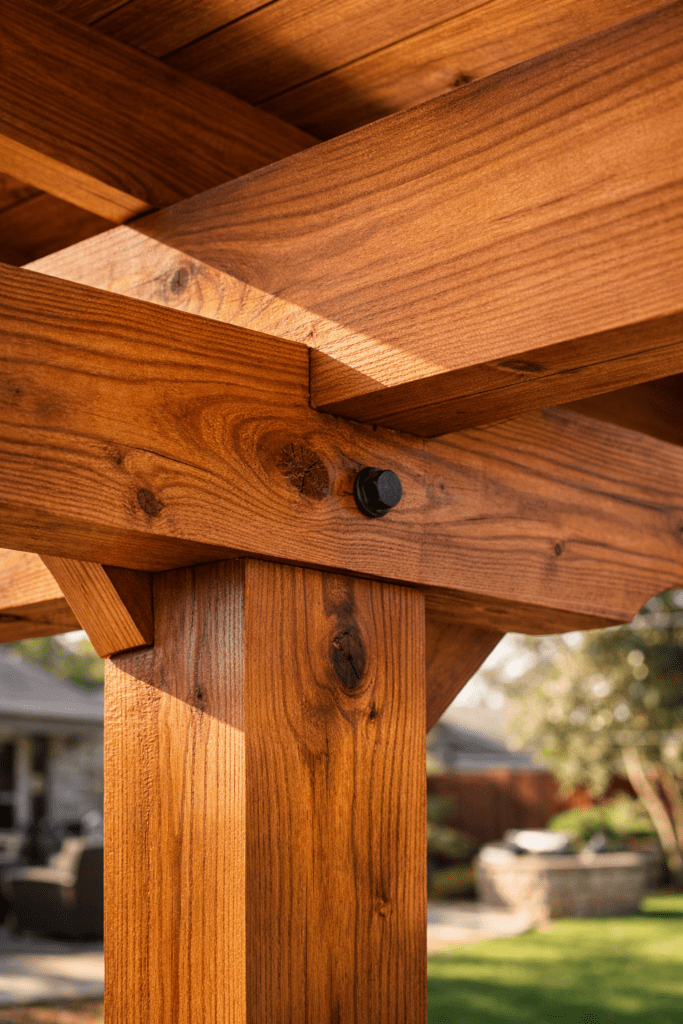
Cedar works well in North Texas for reasons that go beyond appearance. Western Red Cedar has a natural cellular structure that resists moisture absorption and dimensional warping — both relevant concerns given the clay soil movement and humidity swings common to Denton County. Unlike pressure-treated pine, which can check and split within a few seasons of North Texas heat cycles, cedar holds its shape and finish longer with basic maintenance.
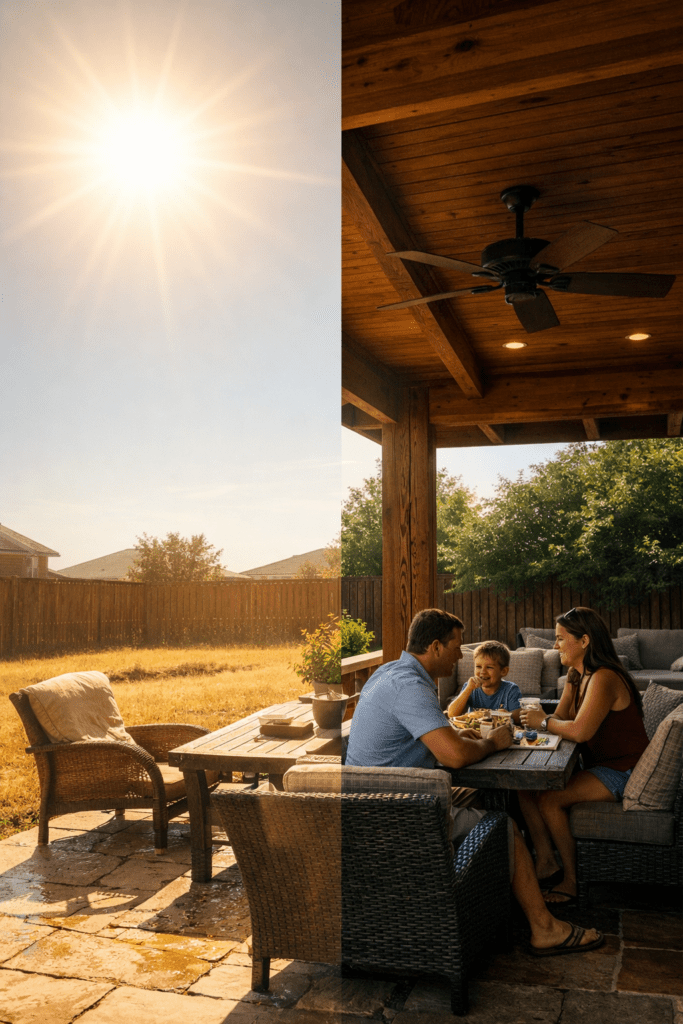
Shade alone makes a measurable difference. The U.S. Department of Energy has documented that shade structures can reduce surface temperatures on adjacent patios and decking by 20-30°F, which translates directly into usable hours. A covered cedar patio in Aubrey can be comfortable by late afternoon even in August — a claim that sounds modest until you’ve spent a summer without one.
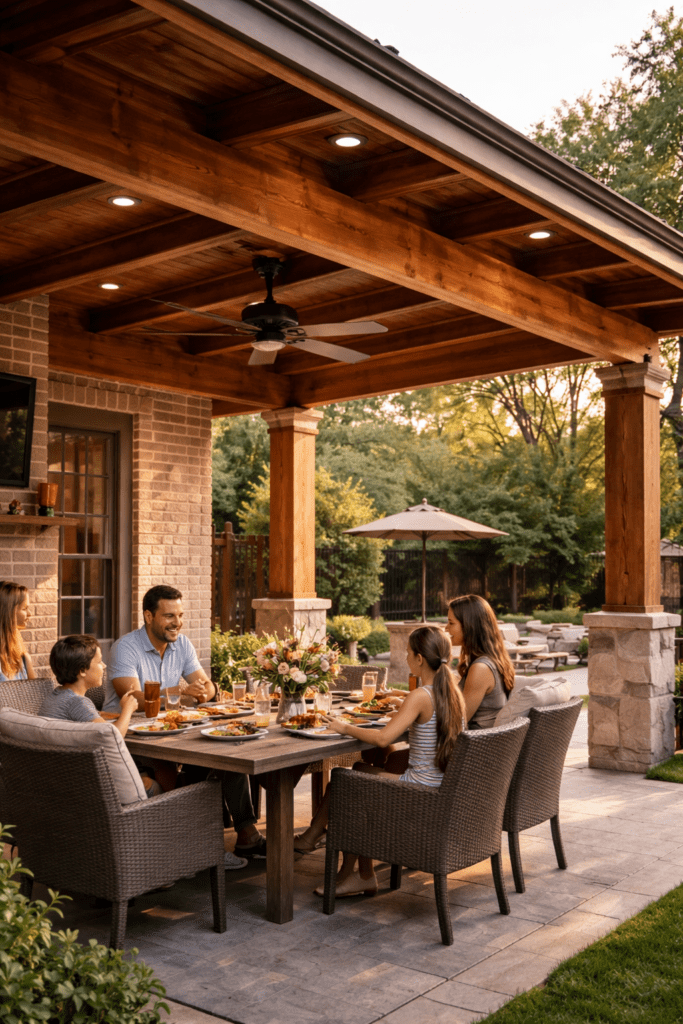
For Aubrey’s newer homes on larger lots, cedar structures offer design flexibility that metal or vinyl alternatives don’t. Cedar can be cut, shaped, and detailed to complement both modern farmhouse exteriors common in Silverado and the more traditional ranch aesthetics found on older acreage properties. The material scales well — from a simple 12×16 attached cover to a 30-foot freestanding structure with integrated lighting and ceiling fans. This matters on half-acre and larger lots where a small structure looks out of proportion with the property.
Cedar is also one of the few materials that improves in appearance over time with proper maintenance — developing a silver-gray patina if left natural, or holding a rich stained tone with a fresh coat every two to three years.
Cedar Patio Cover Options for Aubrey Properties
Attached Cedar Patio Covers connect directly to the home’s existing roofline or exterior wall, creating a covered extension of the interior living space. These are the most common choice for Aubrey homeowners whose back door opens to an uncovered slab. Cost typically runs $8,000–$18,000 depending on size and finish, with most projects completing in one to two weeks. Because the structure ties into the home, Denton County requires a building permit, and the connection method must meet current IRC code for ledger attachment.
Freestanding Cedar Pergolas stand independent of the home, which gives them placement flexibility across larger lots. They work well as shade structures over outdoor kitchens, fire pit areas, or detached seating zones set back from the house. Pricing generally falls between $6,000 and $15,000, with a one-to-two week build window. On Aubrey’s expansive clay soils, footer depth for freestanding posts is not a detail to skip — proper depth prevents the seasonal heave that can rack a structure within a few years.
Cedar Patio Covers with Solid Roofing add a full weatherproof roof — typically metal standing seam or architectural shingles — to the cedar frame. This is the right choice for homeowners who want year-round use regardless of rain, or who plan to add ceiling fans, lighting, or an outdoor TV. Cost ranges from $12,000 to $25,000 or more depending on roofing material and square footage, with a two-to-three week timeline. These structures are particularly well-suited to Aubrey’s spring storm season.
Custom Cedar Structures cover anything outside the standard configurations — L-shaped covers wrapping a corner, structures connecting a home to a detached garage, or large-scale outdoor rooms with multiple zones. Pricing varies based on scope, and timelines typically run two to four weeks. For the larger acreage properties outside Aubrey’s master-planned communities, custom builds are often the only option that fits the property correctly.
How We Build Cedar Patio Covers in Aubrey
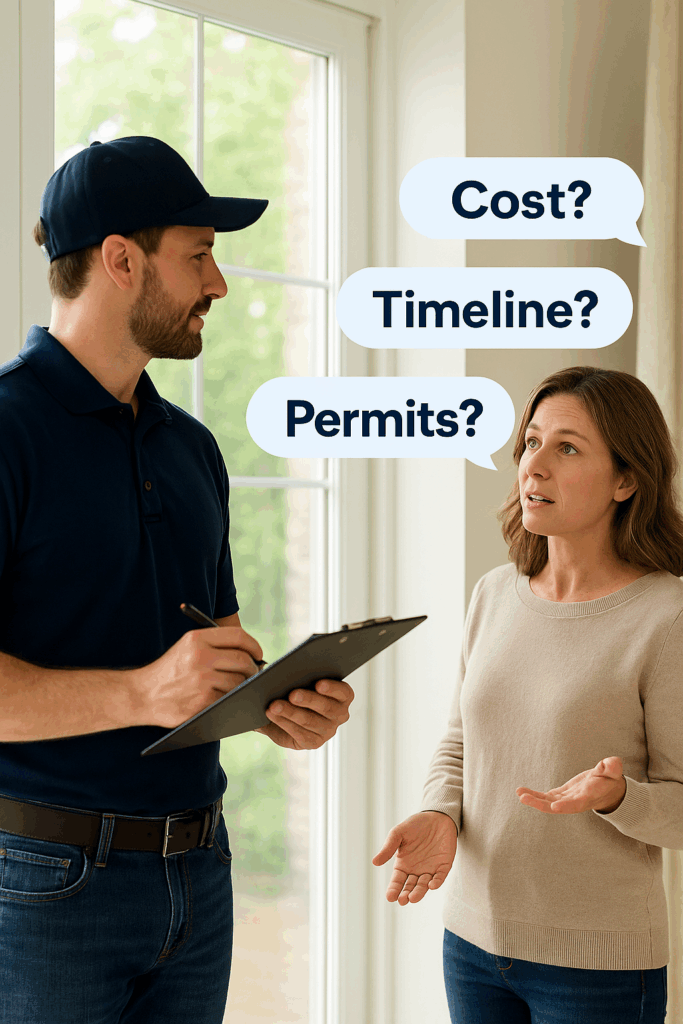
The process starts with an on-site consultation. We walk the property, measure the space, review the home’s exterior structure (for attached covers), and discuss how the family actually uses — or wants to use — the backyard. This conversation shapes everything that follows.
From there, we move to design. We produce drawings that reflect the actual dimensions, roof pitch, post placement, and connection points. For attached structures, this includes confirming the ledger attachment method and verifying that the existing home structure can support the load. For freestanding builds on clay soil, we determine footer depth at this stage.
Material selection happens before any permits are pulled. We confirm wood grade, finish preference (natural, stained, or painted), roofing material if applicable, and any hardware or accessory details like fan blocking or electrical rough-in locations. Once materials are specified, we submit for permits.
Permitting in Denton County is required for attached structures and most freestanding structures above a certain size. HOA approval requirements vary significantly across Aubrey’s subdivisions — Silverado and The Palomas both have active architectural review processes, while some older sections of Aubrey have minimal HOA oversight or none at all. We handle the permit submission; homeowners are responsible for HOA applications, though we provide drawings and documentation to support that process.
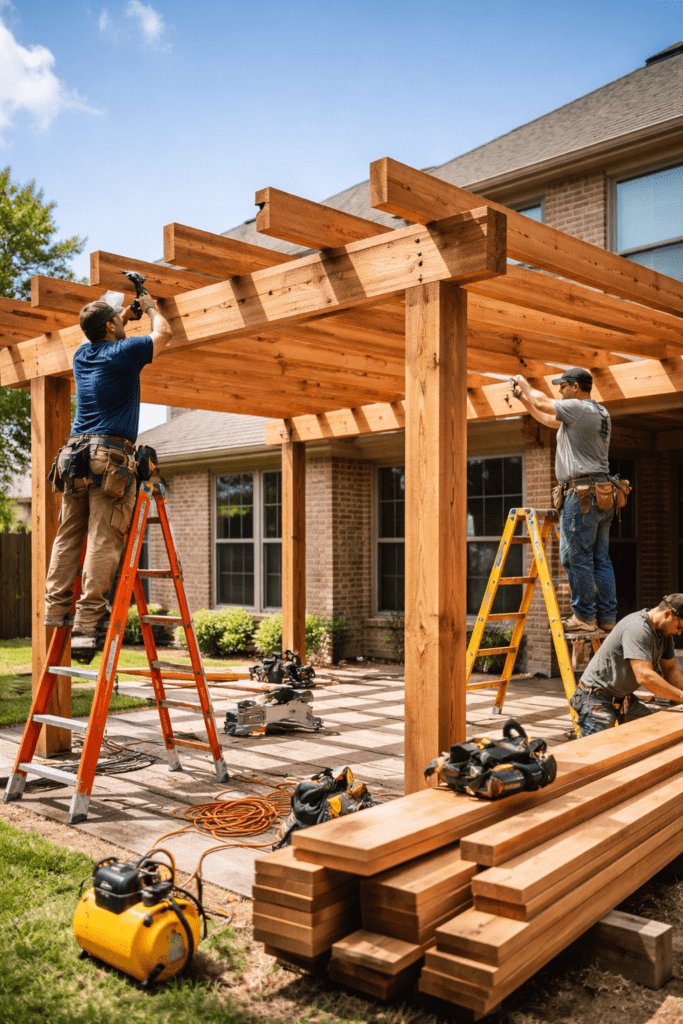
Construction follows permit issuance. A typical attached cedar cover takes three to five business days on-site for a crew working a standard project. Larger or more complex structures take longer. We do not subcontract the structural work.
The final walkthrough covers finish quality, connection points, drainage, and any punch-list items. Call us at (469) 312-0990 to schedule a consultation.
How Much Do Cedar Patio Covers Cost in Aubrey?
The honest answer is that price depends on four variables: structure type, square footage, roofing, and site conditions. A straightforward 12×16 attached cedar cover with an open-beam roof runs toward the lower end of the $8,000–$18,000 range. A 20×24 attached cover with a solid metal roof, ceiling fan blocking, and electrical rough-in sits at the upper end or beyond.
Aubrey-specific factors push costs in predictable directions. Larger lots mean homeowners frequently want larger structures — a 12×16 cover looks undersized on a lot where the backyard runs 150 feet deep. That scale-up adds material and labor costs. Clay soil footer requirements add modest but real cost to freestanding structures; cutting corners here creates structural problems within a few years as the soil moves seasonally.
HOA requirements in subdivisions like Silverado can specify roofing materials, post dimensions, or finish colors that affect material selection. These aren’t deal-breakers, but they can narrow options and occasionally require premium materials to meet the standards. We review HOA guidelines before finalizing a proposal so there are no surprises after construction begins.
As a general planning figure: budget $150–$250 per square foot for a finished cedar patio cover in Aubrey, with open-beam structures at the lower end and solid-roof custom builds at the upper end.
Credentials and Industry Standards
The JBN Group holds verified credentials with the Better Business Bureau (BBB) and the National Association of the Remodeling Industry (NARI). We are also Directorii verified and Google Guaranteed. All work is fully insured — general liability and workers’ compensation — which matters on residential projects where the homeowner’s property and household are in proximity to active construction.
Attached patio covers in Denton County fall under the International Residential Code (IRC) as adopted by Texas, which governs ledger connections, post sizing, beam spans, and footer requirements. These aren’t bureaucratic formalities — they’re the standards that determine whether a structure stays plumb and connected to your home for twenty years or starts pulling away from the wall after three.
The U.S. Department of Energy’s research on shade structures supports what experienced builders already know: properly designed overhead shade reduces cooling loads on adjacent interior spaces, particularly in climates with sustained high-UV summers like North Texas. A cedar patio cover over a south- or west-facing back wall isn’t just a comfort improvement — it reduces the thermal load on that wall during peak afternoon hours.
Serving Aubrey and Surrounding Communities
The JBN Group works throughout northern Denton County and the surrounding region. In Aubrey, we’ve built structures in Silverado, The Palomas, Pristine Place, Jackson Ridge, and Aubrey Creek Estates, as well as on older acreage properties along FM 428 and the surrounding rural areas.
We also serve Providence Village and Pilot Point to the north, where lot sizes and property types are similar to Aubrey’s mix of newer construction and established ranch homes. To the south and east, we work regularly in Celina, Prosper, and Little Elm — communities experiencing the same rapid growth pattern as Aubrey. Krugerville, Cross Roads, and Savannah round out our regular service area in the immediate region.
For homeowners anywhere in this corridor, the combination of large lots, newer construction without existing shade structures, and North Texas climate conditions makes cedar patio covers one of the highest-value outdoor living improvements available. If your property is outside the cities listed here, contact us directly — our service area extends throughout Denton County and into adjacent counties.
Frequently Asked Questions
How much does a cedar patio cover cost in Aubrey, TX?Most cedar patio covers in Aubrey fall between $6,000 and $35,000 depending on structure type, size, and roofing. Attached covers with open-beam roofs typically start around $8,000, while custom structures with solid roofing and accessories can exceed $25,000. Lot size and clay soil footer requirements specific to Aubrey can influence the final number.
How long does installation take?Most projects complete within one to three weeks from the start of construction. Attached covers and freestanding pergolas on standard lots typically take one to two weeks on-site. Larger custom structures or projects requiring more complex permitting run two to three weeks or longer.
What type of cedar do you use?We build with Western Red Cedar, which is the industry standard for outdoor structures in North Texas. It has natural oils that resist moisture and insects, holds stain well, and handles the heat and UV exposure of a Texas summer better than most alternative species.
Do I need a permit for a patio cover in Aubrey?Yes, Denton County requires building permits for attached patio covers and most freestanding structures of significant size. HOA approval requirements vary by subdivision — Silverado and The Palomas have active architectural review boards, while some older Aubrey neighborhoods have minimal or no HOA oversight. We handle the county permit submission and provide documentation to support your HOA application.
How long does a cedar patio cover last?Western Red Cedar structures built to code and properly maintained typically last 20 to 30 years. Applying a quality exterior stain or sealant every two to three years is the primary maintenance requirement. Neglected cedar will weather to a silver-gray patina that is structurally sound but less finished in appearance.
What’s the best patio cover option for a large Aubrey lot?For lots of half an acre or more, a freestanding cedar structure or a large attached cover with a solid roof typically makes the most sense. Large open lots need proportionally sized structures — a small attached cover can look out of scale and doesn’t address the full usable area. Freestanding pergolas work well for creating distinct zones across a deep backyard, such as separating a dining area from a fire pit or outdoor kitchen.